Similarities and Differences versus a Robotic hip?
When undertaking a conventional hip replacement meticulous planning remains essential. The objective of surgery with or without robotic assistance is to restore the hip centre, match leg lengths and tissue tension around the hip. This approach reduces dislocation rates, improves longevity and patient satisfaction.
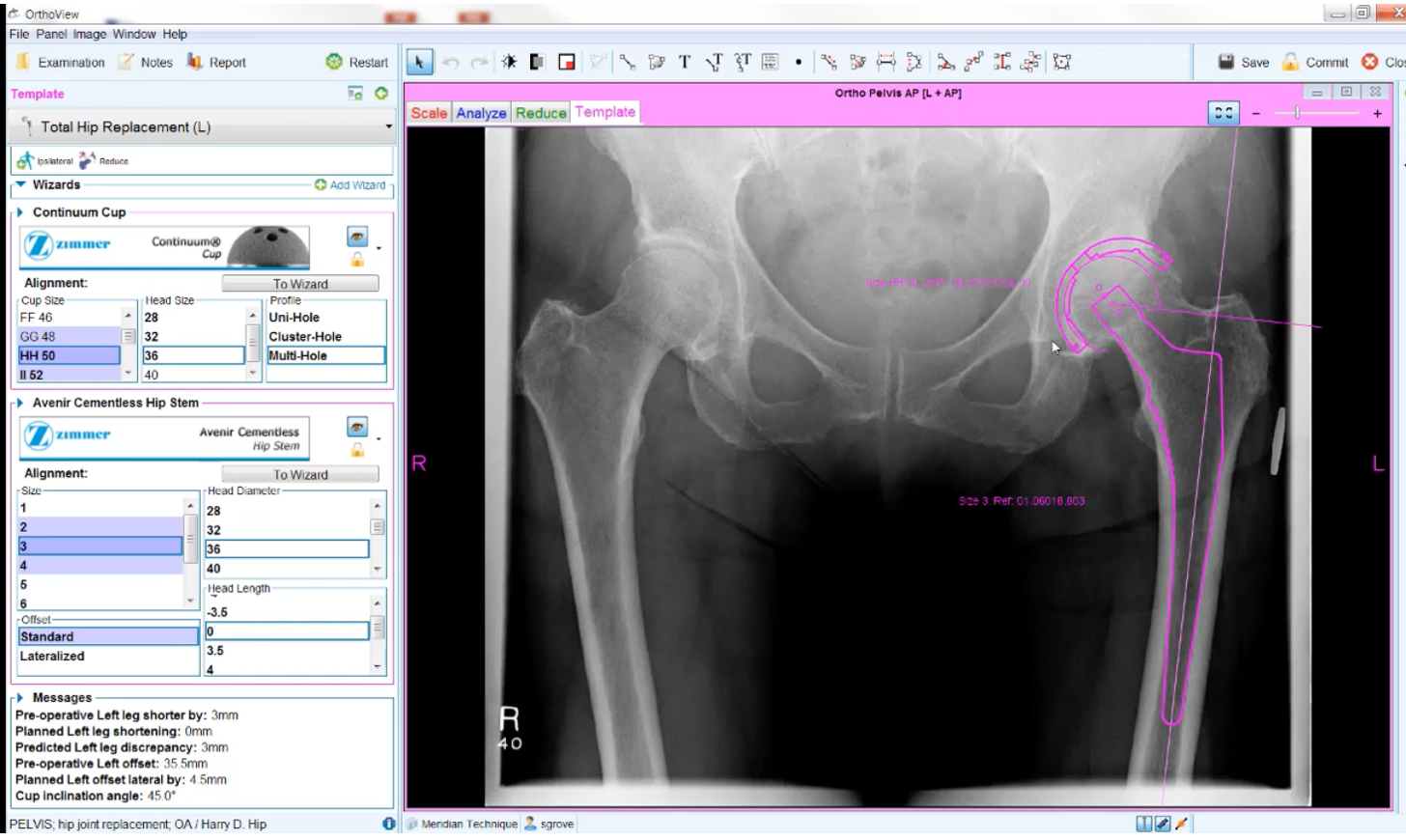
Planning is based solely on pre-operative x-rays and has limitations compared to CT scans. There is assumed magnification with x-rays and planning is based on a two-dimensional image despite the hip being a three-dimensional structure. Pre-operative planning has remained an integral part of my practice throughout my training and continues to be so.
The implants used in both robotic and conventional hip replacements are identical.
The surgical approach is also the same in both types of hips. However, for robotic hips an additional incision is made on the brim of the pelvis above the hip where the pelvis array sits. This allows the computer to know the position of the pelvis at all times and to match the CT scan to the patient’s anatomy. This is not required in conventional hips.
Surgical planning – Templating
Templating software is used to measure pre-operative leg lengths and assist in estimating the size of the stem and cup required for a total hip replacement. This enables a clearer understanding of the appropriate implant size for the operation and guides the optimal positioning of the implants to achieve leg length and soft tissue balance around the hip.